A short interview turns trade fair footage into a statement. For it to work, the questions, the sound and the subtitles have to be right, in a hall that is rarely quiet. Here is the routine that works on the stand.
All prices plus VAT · delivered within 24 hours · See all packages & details
An interview is worth it whenever someone can say something that pictures alone cannot show: why a product was developed, what a customer achieves with it, why a distributor chose to represent your brand. At a trade fair these people are in one place, often for the only time that year. That makes your stand a good location, despite the noise.
Typical interviewees are your managing director, product leads, existing customers, distributors and partners from other countries. Their statements later appear in the 90-second trade fair film, in short social clips or as a stand-alone testimonial. A few minutes of interview often produce several edits.
For exhibitors travelling to Germany from the Gulf, Asia or the US, the show is also the easiest moment to film European customers and partners who are hard to reach otherwise.
Good interview questions cannot be answered with yes or no. They start easy and then get more specific. This order works well:
Two rules make the edit easier. First, ask the person to include the question in the answer, speaking in full sentences, because the question itself will be cut. Second, wait two seconds of silence after each answer. The best sentence often comes then.
Send the questions a few days ahead, but not scripted answers. Memorised lines sound stiff on camera.
Exhibition halls are loud. Speakers on the next stand, announcements, conversations in the aisle, machines running. Pictures can often be rescued in the edit; bad sound rarely can. That is why sound comes first.
A quick test recording checked on headphones shows immediately whether the background is too strong. It takes a minute and saves trouble later.
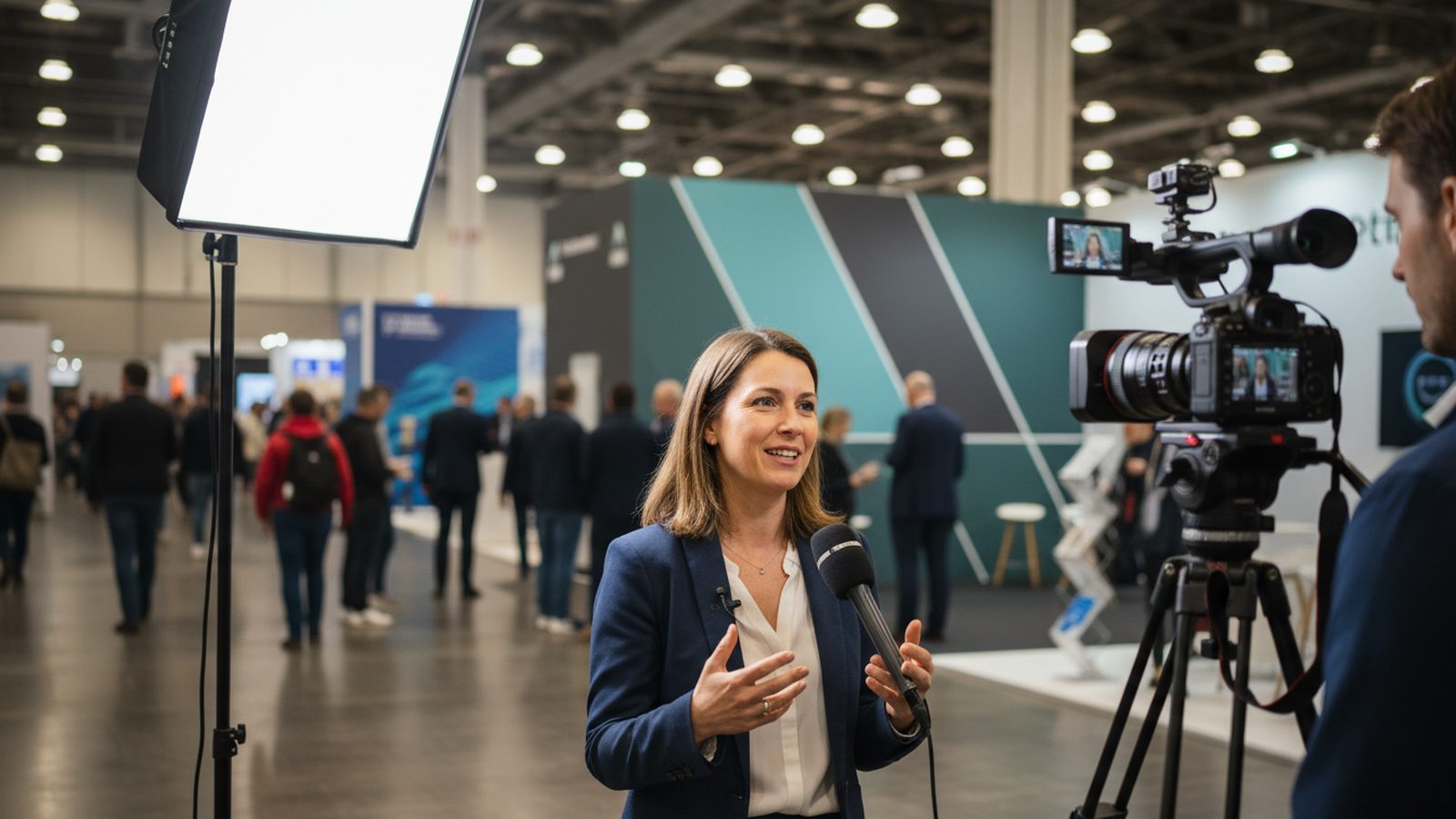
The background should show where the interview takes place: the stand wall with your logo, the product, a busy stand (booth). It should not distract. Visitors walking directly behind the speaker's head or a flickering screen pull attention away from the face.
The speaker usually looks slightly past the camera at the person asking the questions. That feels like a conversation and takes the pressure off. For short social clips a direct look into the lens can make sense; decide that in advance. Hall lighting is often flat or has a colour cast, so a small light to one side of the face makes a clear difference.
Standing is usually more natural on a stand than sitting. Allow about fifteen minutes per person, including fitting the microphone, a test and two takes.
Most interview clips are started without sound, so subtitles are not an extra but a requirement. For international exhibitors there is also the language question. Let each person speak in the language they are most confident in. A fluent sentence in Arabic with English subtitles comes across better than a hesitant sentence in English.
At Pixer we conduct interviews in English, German, Arabic and Persian and deliver subtitles in those languages. For the subtitles, keep in mind:
For several markets at once, read our guide to multilingual subtitles.
Anyone interviewed has to agree to the recording and the planned use, ideally in writing. That matters most for customers and partners who are not part of your company. A simple template and practical notes are in our guide to consent for on-stand interviews.
Schedule interviews at fixed times and give each interviewee a contact on the stand who brings them to the spot. Customers have full diaries at a show. Someone booked for 10:30 is more likely to turn up than someone asked to drop by at some point. Interviews are included in the Full Day package and can be added to smaller packages together with a 90-second film for €190. See our testimonial video service for more.
Start easy, then get specific. Answers in full sentences.
Clip-on microphone, a quiet time slot, back to the noise, a quick test.
Logo and stand visible, but no visitors walking right behind the head.
Everyone speaks the language they are most confident in. Subtitles translate.
Written agreement, especially from customers and partners.
About fifteen minutes per person, with a set time and a contact on the stand.
Recording usually takes a few minutes. Often only two or three sentences make it into the finished film, so ask a few good questions rather than many.
Yes, interviews are possible in English, German, Arabic and Persian. Subtitles are translated into the language you need.
Move the time slot, change the spot, turn the speaker's back to the noise. A clip-on microphone picks up the voice far more strongly than the background.
No. Looking slightly past the camera at the interviewer feels more natural. For short social clips a direct look can make sense.
Either the videographer or someone from your team. What matters is that the questions are agreed in advance and the interviewer stands next to the camera.
Yes. You receive the edit for approval and two revision rounds are included. Customers and partners should also see their statements before publication.
Want to put customers or partners on camera at the show? Tell us the fair, the date and the interview languages and we will plan the routine with you.
We reply within 24 hours. During a show week, WhatsApp is fastest.
