Conversation shots prove that visitors are interested in what you offer, yet they are the hardest images of the show. This guide explains how to prepare your team, how a photographer captures real moments and what to consider about consent.
All prices plus VAT · delivered within 24 hours · See all packages & details
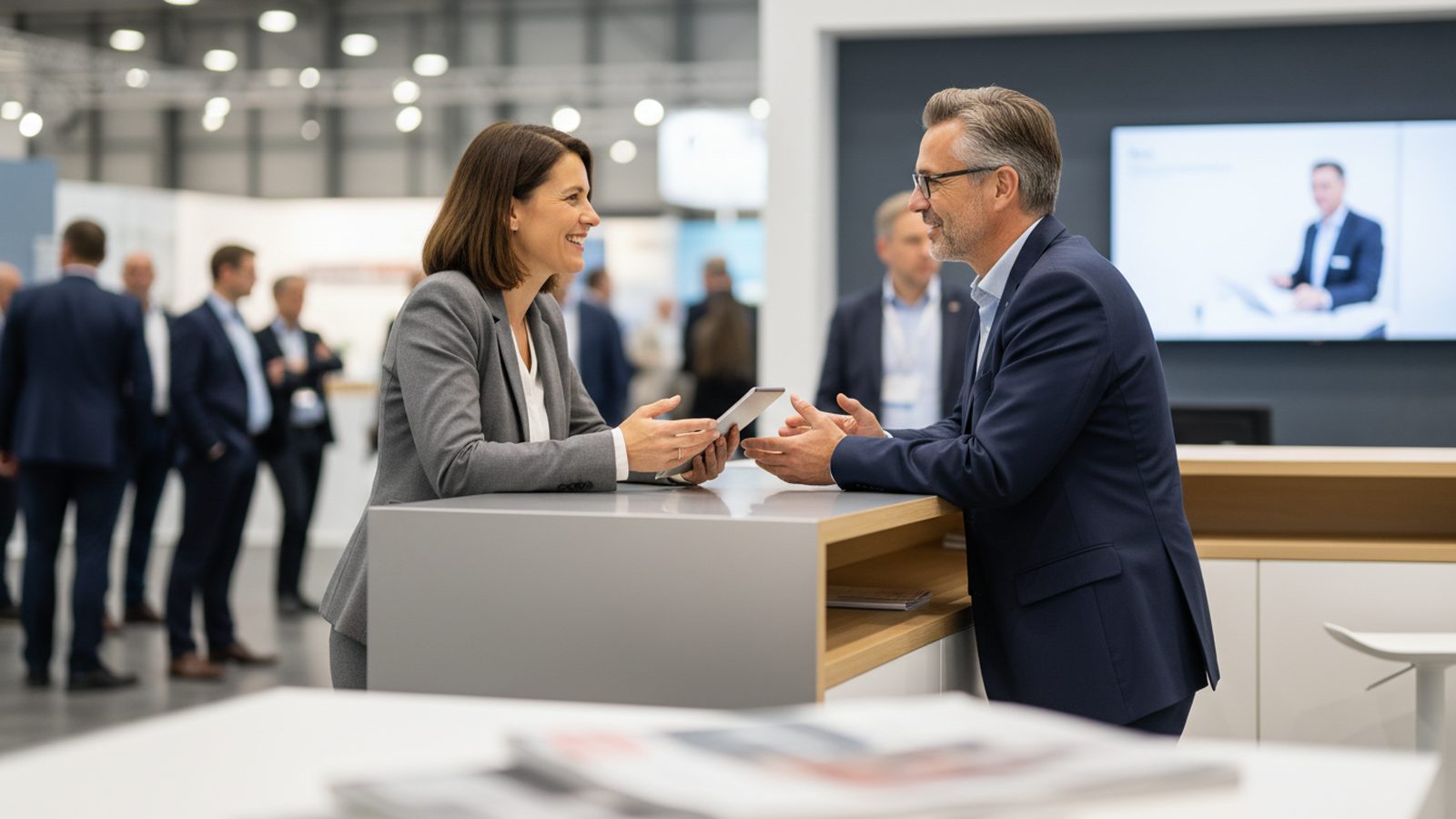
A photo of your stand shows that you were there. A conversation photo shows that someone was interested in you. For LinkedIn, sales decks and the report to head office, that is often the more important picture: people turning towards a product, a team member explaining something, a visitor asking a follow-up question.
Yet these are the hardest images to get. Real conversations cannot be repeated, and as soon as someone notices the camera, their body language changes. Staged scenes, on the other hand, are obvious at a glance: the handshake aimed at the lens, two people smiling at a blank tablet, colleagues pretending to be customer and adviser.
Good conversation photos come from a mix of preparation, restraint and timing. The sections below show what that looks like on a real show floor.
You cannot brief visitors, but you can brief your stand staff. Five minutes before the show opens is enough:
If your stand team comes from different countries or partner companies, run this briefing in English and keep it short. The guide briefing stand staff covers dress, posture and on-camera conversations in more depth.
Equipment is secondary. What matters is how the photographer moves around your stand (booth). This is how we work at Pixer:
Our crew is two to three people on site and moves so that sales conversations are never interrupted. For many exhibitors, that is the single most important point.
Recognisable visitors raise legal questions. The rules depend on the country, the purpose of publication and the organiser's terms. At shows in Germany and across the EU, data protection rules apply, and they may be stricter than what your team is used to at home. In practice, a few principles have proven reliable:
For binding advice, ask your legal team or data protection officer. The guide image rights at trade fairs gives an overview.
Not every scene has to happen by chance. In some situations a prepared shot is the better choice:
What does not work: dressing up your own staff as visitors, posed handshakes looking into the camera, or groups crowding around an exhibit for a photo. Those images cost more credibility than they earn.
Plan conversation shots for late morning and early afternoon, when the stand is busy. A two-hour basic package is enough for a solid series. Packages, delivery and invoicing without German VAT for non-EU companies are explained on trade fair photographer Germany.
Conversation shots prove interest in your offer, which makes them especially valuable.
The team keeps talking when they notice the photographer. A look at the camera ruins the shot.
Longer lenses from two to four metres do not disturb any sales conversation.
Close-ups at the exhibit tell the story without recognisable faces.
Recognisable visitors should know photos are being taken and agree.
Tell the photographer when key customer meetings are planned.
Not if they keep a distance and work with longer lenses. Your sales team should still be able to signal at any time that a conversation should not be photographed.
Then they are not photographed, and any images already taken are removed from the selection. A short, friendly question from your team usually settles it on the spot.
Two hours of show time usually produce several strong series. It depends on how busy the stand is and whether the team was briefed beforehand.
Not when your team member faces the camera and the scene has a clear action. Over-the-shoulder images often feel more authentic than frontal portraits.
Yes. We usually deliver the first images the same day, so you can show on LinkedIn and to head office that your stand is busy. The full selection follows within 24 hours.
Not if the conversation is real and only the timing was agreed. That is the most honest solution for quiet periods at the show.
We photograph conversations on your stand from a distance, without interrupting sales, and usually deliver the first images the same day.
We reply within 24 hours. During a show week, WhatsApp is fastest.
